

Choosing between a fulfillment center vs warehouse isn’t about splitting hairs over logistics terminology. It’s about selecting the right infrastructure that directly impacts your margins, customer experience, and ability to scale. For product businesses navigating growth, this decision shapes everything from your cash flow to customer retention rates.
Most businesses stumble here because they treat these facilities as interchangeable. They’re not. Gembah works with hundreds of product entrepreneurs moving from concept to market, and we consistently see fulfillment strategy determine whether a promising product thrives or bleeds cash through hidden costs and operational mismatches.
TL;DR: Fulfillment Center vs Warehouse
Fulfillment centers handle rapid order processing for individual customers, using advanced technology and multiple daily carrier pickups to enable same-day or next-day delivery. Warehouses provide long-term bulk storage with infrequent shipments to retailers or distributors. The choice hinges on whether you’re shipping directly to consumers at high velocity or storing inventory for future bulk distribution.
Key Points:
- Inventory turnover: Fulfillment centers average 5-7 turns annually for e-commerce versus 7-10 turns for retail warehouses, reflecting fundamentally different storage horizons
- Cost structure: Fulfillment centers charge per-order fees for picking, packing, and shipping, while warehouses bill primarily for space and basic handling
- Hidden expenses: Long-term storage premiums can surge to 3x standard rates, and return processing costs hit $4.50-$8.50 per return
- Hybrid models: 20-30% order processing gains emerge from combining both facilities, allocating fast-movers to fulfillment centers and bulk inventory to warehouses
Fulfillment Center vs Warehouse (Definitions That Actually Matter)
Understanding what a fulfillment center actually does versus traditional warehousing cuts through marketing fluff and gets to operational reality.
What a warehouse does
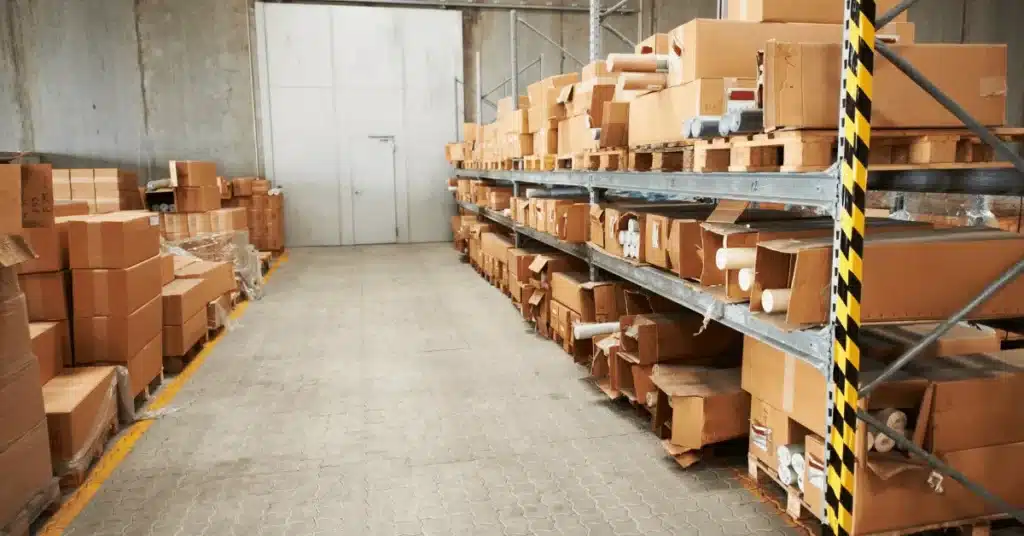
Warehouses focus on long-term bulk storage, holding goods for months or years until needed. Employees receive shipments, organize inventory by SKU, monitor stock levels, and prepare occasional bulk transfers to retailers or distribution centers.
Modern warehouses target 7-10 inventory turns yearly for retail distribution, translating to average storage horizons of 36-52 days per cycle. They’re built for holding seasonal surplus, raw materials awaiting production runs, or products distributed through traditional wholesale channels.
What a fulfillment center does
Fulfillment centers execute the complete order workflow: receiving inventory, picking individual items, packing them for shipment, labeling packages, coordinating carrier pickups, and processing returns. Products arrive in bulk but leave as individual parcels addressed to customers.
These facilities run on warehouse management systems, automated conveyor belts, robotics for picking, and real-time inventory tracking across multiple sales channels. E-commerce fulfillment centers average 5-7 turns per year, with storage horizons around 52-73 days reflecting their role as active processing hubs rather than static repositories.
The business model difference
Warehouses serve B2B relationships, moving products in bulk to fewer destinations. A warehouse might ship 10 pallets weekly to regional retailers. Fulfillment centers serve both B2B and B2C channels, processing thousands of individual orders daily to unique residential addresses.
This distinction drives every operational choice. Warehouses employ forklift operators and inventory clerks. Fulfillment centers need quality control specialists, packing station workers trained on custom kitting, customer service teams handling delivery exceptions, and IT staff maintaining integration with multiple e-commerce platforms.
The Operational Differences (Picking, Packing, Shipping, Returns)
Operations separate fulfillment centers from warehouses in ways that directly impact your customer promises and unit economics.
Inventory turnover and storage horizon
Inventory velocity tells the real story. The industry average sits at 8.5 turns yearly across sectors, but fulfillment centers handling fast-moving consumer goods push higher. High-performance e-commerce operations achieve 8-12+ turns annually, while warehouses managing slower products like capital goods drop to 2-6 turns.
Storage duration creates the cost divergence. Products sitting longer accumulate fees. Your turnover rate signals which model fits. Products moving fewer than 6 turns yearly suggest warehouse storage makes economic sense. Items exceeding 10 turns demand fulfillment center speed to capture customer expectations for rapid delivery.
Order profile (B2C parcels vs B2B pallets)
B2C fulfillment centers handle high-frequency, low-volume individual items picked from inventory and packed into branded boxes for residential delivery. They use batch picking strategies, pulling multiple orders simultaneously to improve efficiency.
B2B warehouses manage low-frequency, high-volume palletized shipments to business locations. A single order might involve 500 units shrink-wrapped on pallets with complex documentation for wholesale receiving departments.
This volume distinction affects carrier relationships. Fulfillment centers negotiate with UPS, FedEx, and regional parcel carriers for residential delivery. Warehouses work with freight companies specializing in less-than-truckload and full truckload shipments.
Carrier pickup frequency and cutoff times
Fulfillment centers receive multiple carrier pickups daily, coordinating with different shipping services to hit delivery promises. Typical cutoff times around noon enable same-day processing for next-day delivery.
Warehouses operate on less frequent pickup schedules, often weekly or as freight consolidates. Pickup scheduling accommodates partial truckload and less-than-truckload shipments, which pool inventory across locations for cost efficiency but extend turnaround times.
During peak seasons, this difference compounds. One e-commerce brand increased daily pickup capacity from one truckload to five by distributing inventory across multiple fulfillment facilities, enabling localized carrier coordination impossible with centralized warehouse storage.
Cost Drivers and Tradeoffs (What You’re Really Paying For)
Understanding cost structures prevents the budget surprises that sink margins.
Warehouse cost structure
Warehouses charge primarily for space. Typical pricing runs per pallet position or cubic foot per month, with rates averaging $0.78 per cubic foot monthly during off-peak periods. Additional fees cover receiving, inventory counts, and occasional order prep for bulk shipments.
Long-term storage creates the hidden trap. Long-term storage premiums surge to 1.5-3x standard rates for inventory exceeding 30-90 days. A seller with 500 cubic feet of slow-moving products faces $390 monthly in off-season but $1,200 during peak periods, an $810 monthly swing that devours profitability.
Fulfillment center cost structure
Fulfillment centers charge per-order fees encompassing picking, packing, and shipping coordination. Typical costs run $2-4 per order for pick and pack, plus shipping charges of $5-15 depending on package size and destination. For businesses processing 1,000 monthly orders, fulfillment costs might hit $7,000-$19,000 monthly before storage, explaining why fulfillment averages 12-18% of total revenue for many small businesses.
Volume creates negotiating leverage, but during seasonal peaks, surcharges of $0.40-$1.20 per package can eliminate margins on thin-profit products.
The hidden costs that kill margins
Long-term storage premiums, payment processing leakage, and return logistics represent the margin killers most businesses discover too late. These costs often comprise 30-40% of total fulfillment expenses but remain invisible until they’ve accumulated significantly.
Payment processing fees drain 2.5-3.5% plus $0.10-$0.30 per transaction, with cross-border conversions adding another 1-3%. Return processing costs $1.50-$3.50 per order, with return shipping adding $3-8 per return. Apparel businesses facing 20-30% return rates and processing 1,000 monthly orders lose approximately $4,250-$10,000 monthly to return handling alone.
Hidden surcharges compound unpredictably. Address correction fees hit $18-22 per occurrence, EDI setup runs $500-$1,500 one-time, and monthly minimums jumped from $337.50 to $517 year-over-year in many 3PL contracts.
What Gembah sees in practice: Product design’s hidden impact
Product characteristics drive fulfillment costs more than most entrepreneurs realize. Package dimensions, weight, and materials determine whether your margins survive or collapse under fulfillment fees. Fulfillment costs represent 12-20% of e-commerce revenue, with product design decisions made during development locking in these costs permanently.
Working with product businesses from concept through manufacturing, we see how oversized dimensions trigger carrier surcharges, excess weight multiplies per-pound charges, and inefficient packaging wastes material and labor costs. Brands reducing box sizes to fit standard carrier thresholds avoid oversize surcharges that compound at scale. Thoughtful packaging optimizations cut shipping fees significantly when applied across thousands of orders.
Products requiring special handling or fragile protection inflate packing labor and damage rates. Irregular shapes complicate picking and storage, while complex multi-variant SKUs slow processing. Streamlining to standard rectangular shapes cuts handling time. Simplifying SKU structures reduces errors.
The businesses that succeed optimize products for fulfillment requirements during design and sourcing, not after inventory arrives at the warehouse. This means targeting weight ranges that minimize shipping costs, choosing materials and packaging that reduce dimensional weight charges, and building sufficient margins to absorb fulfillment fees while remaining competitive.

Decision Framework (Choose the Right Model in 5 Minutes)
Selecting between warehouse and fulfillment center models comes down to five variables: order velocity, customer type, delivery expectations, inventory characteristics, and operational capacity.
Choose a fulfillment center if…
Your business ships directly to consumers with 42% demanding 2-day delivery and needs daily carrier coordination. E-commerce operations processing 100+ orders daily benefit from fulfillment center infrastructure designed for parcel velocity. Products with high turnover exceeding 8-10 annual cycles justify the per-order costs because inventory doesn’t accumulate storage fees.
Fast-moving consumer goods, subscription boxes, and products requiring custom kitting or branded packaging experiences need fulfillment center capabilities. You lack the infrastructure for reliable same-day order processing. For businesses under 5,000 monthly orders, outsourcing often costs less than maintaining equivalent internal operations.
Choose a warehouse if…
Your products move in bulk to business customers or retail partners. B2B shipments going to fewer destinations in larger quantities don’t require parcel fulfillment speed. The lower storage costs for holding inventory 60-90 days suit seasonal products or businesses managing longer sales cycles.
Low inventory turnover under 6 cycles yearly indicates warehouse storage makes economic sense. Products with unpredictable demand spikes benefit from holding buffer stock without triggering the per-order fees that fulfillment centers charge every time inventory moves.
Consider a hybrid when…
Your catalog includes both fast-movers and slow-movers with different customer profiles. Major retailers demonstrate this approach: Target fulfills over 80% of online orders from stores, reducing overall fulfillment costs by roughly 40% and same-day costs by 90% through proximity to customers. Walmart processes more than half of online orders from stores, using micro-fulfillment centers for rapid delivery while maintaining distribution centers for bulk inventory.
Seasonal demand creates periods of rapid fulfillment followed by extended storage. Allocating 60% of inventory to fulfillment centers during peak months and shifting to warehouse storage during slow periods optimizes costs based on actual order flow. Geographic distribution matters for delivery speed. Multiple fulfillment centers serving regional markets provide faster delivery than single-location warehouses, while maintaining central warehouse storage for inventory replenishment reduces overall storage costs.
Specific triggers for hybrid models: If your fast-movers represent 70% of volume but only 30% of SKUs, hybrid models typically show positive ROI within 3-6 months. When seasonal peaks drive 3x normal order volumes for 60-90 days annually, splitting inventory between facilities prevents capacity constraints and long-term storage penalties during slower months.
Warning Signs You Chose Wrong (And What to Do About It)
Most businesses discover fulfillment mismatches through declining metrics that signal deeper structural problems. These warning signs appear weeks before profit erosion becomes obvious.
Sign 1: Order dwell time exceeding 24-48 hours
Orders lingering longer than 24-48 hours in picking/packing stages signal throughput bottlenecks before customer complaints arrive. This happens when fulfillment center capacity doesn’t match order velocity or warehouse processes can’t handle individual order requirements.
Immediate action: Segment dwell time by SKU and channel. Identify which products or sales platforms create delays, then reallocate those SKUs to facilities better suited for their velocity. Implement batch picking for high-volume items to reduce processing time.
Sign 2: On-time shipping rates dropping below 95%
Even slight dips below 95% on-time delivery, especially during normal demand periods, reveal strain from poor model fit. This indicates your current facility lacks the carrier coordination, cutoff time structure, or processing speed customers expect.
Immediate action: Review carrier performance by delivery zone and switch carriers for problematic regions. Add backup carrier relationships to maintain redundancy during capacity constraints. Consider additional fulfillment locations to improve geographic coverage.
Sign 3: Picking errors or manual interventions exceeding 2-5%
Order accuracy below 95% or spikes in “manual intervention required” orders point to process flaws. Warehouses handling too many small orders make more picking errors. Fulfillment centers storing too many slow-moving SKUs create picking complexity that increases mistakes.
Immediate action: Implement warehouse management systems for picking efficiency, targeting 100+ orders per full-time employee daily. Improve pick path optimization and barcode scanning to reduce human error. Simplify SKU complexity through product line rationalization.
Sign 4: “Where is my order?” inquiries exceeding 5-10 per 1,000 orders
Elevated WISMO ticket volume indicates delivery delays or tracking visibility gaps that damage customer perception. This happens when warehouse shipping schedules can’t meet e-commerce delivery expectations or fulfillment centers struggle with inventory accuracy.
Immediate action: Add proactive shipping notifications and tracking updates to reduce customer anxiety. Audit inventory accuracy and cycle count frequency to prevent “ghost inventory” issues. Review carrier delivery performance and adjust shipping methods for problematic zones.
Sign 5: Backorder rates or fill rates below 90-95%
Frequent stockouts despite available inventory signal inventory mismanagement unfit for demand velocity. Warehouses lacking real-time visibility create phantom availability. Fulfillment centers with poor replenishment planning run dry on fast-movers.
Immediate action: Implement reorder point alerts and safety stock calculations to prevent stockouts. Target fill rates above 95% through improved demand forecasting. Consider consignment inventory or vendor-managed inventory programs for high-velocity products.
Your first 90 days after switching models
Days 1-30: Establish baseline metrics for order accuracy, on-time delivery, dwell time, and customer inquiry rates. Monitor daily during transition. Expect 10-15% efficiency loss during the learning curve as teams adapt to new processes.
Days 31-60: Optimize pick paths, carrier relationships, and inventory placement based on initial data. Address recurring bottlenecks through process refinements. Performance should return to pre-transition levels with early improvements emerging.
Days 61-90: Analyze cost per order, storage utilization, and customer satisfaction trends against projections. Calculate actual ROI from the model change. Make final adjustments to SKU allocation, service levels, or facility mix based on real operational data.
Businesses that proactively monitor these metrics during transition identify and correct issues before they compound into revenue problems. The model choice matters less than the vigilance in tracking performance against expectations.
Top 3 Mistakes When Choosing Fulfillment vs Warehousing
Most businesses make avoidable errors that create unnecessary costs or operational bottlenecks.
Mistake 1: Prioritizing lowest cost over total landed cost
Comparing quoted per-order or storage rates misses hidden fees that dominate actual expenses. Businesses chase $2.50 pick-and-pack rates without factoring $18-22 address corrections, peak surcharges of $0.40-$1.20 per package, and return processing costs. The provider with slightly higher base rates but transparent pricing often delivers lower total costs.
Calculate fully loaded cost per order, including storage, handling, shipping, returns, and all surcharges across a 12-month cycle. Compare providers using this comprehensive view instead of cherry-picking individual line items.
Mistake 2: Ignoring inventory turnover when selecting storage horizon
Sending slow-moving inventory to fulfillment centers designed for rapid turnover triggers long-term storage penalties that negate any delivery speed benefits. Conversely, using warehouse storage for products needing daily fulfillment creates delivery delays that cost sales.
Analyze actual turnover by SKU. Products moving 10+ times yearly belong in fulfillment centers. Products turning 4-6 times yearly suit warehouse storage with periodic bulk transfers to fulfillment centers for active selling periods.
Mistake 3: Underestimating operational requirements for self-fulfillment
Businesses assume controlling fulfillment saves money without accounting for the operational burden. Successful merchant fulfillment requires 99% on-time delivery, under 0.5% cancellations, 95% valid tracking, and processing 100+ monthly packages.
Unless you’re investing in warehouse management software, carrier integrations, quality control processes, and dedicated fulfillment staff, outsourcing to experienced fulfillment centers protects your customer experience while you focus on product development and marketing.

Amazon Example (FBA, FBM, and What a “Fulfillment Center” Means in Practice)
Amazon’s fulfillment models demonstrate how warehouse versus fulfillment center choices play out for real product businesses.
FBA as a fulfillment center model
Fulfillment by Amazon operates as a classic fulfillment center service, handling storage, picking, packing, shipping, customer service, and returns for Prime-eligible orders. Sellers send bulk inventory to Amazon’s facilities, which then process individual customer orders with next-day or two-day delivery guarantees.
FBA fulfillment fees run approximately $3.06 for small items to $9.61+ for large bulky products, with typical 1-pound items costing $4.99-$5.00. Monthly storage fees charge per cubic foot, with off-peak rates reduced by $0.09 per cubic foot starting April 2024. Combined, these fees represent 30-40% of selling price for many products.
Amazon introduced inbound placement fees averaging $0.21-$0.44 per unit, low-inventory-level fees for products under 28 days’ supply, and aged inventory surcharges exceeding 271 days. Returns processing costs $1.65-$3.89+ per unit for apparel, with removal fees of $0.25-$0.40+ per standard unit.
FBM as a warehouse or 3PL decision
Fulfillment by Merchant gives sellers control over storage, packing, and shipping while maintaining Amazon listings. This model parallels using your own warehouse or third-party logistics provider instead of Amazon’s fulfillment network. FBM avoids Amazon’s per-unit fees but requires operational infrastructure matching fulfillment center capabilities.
Sellers choosing FBM gain full control over packaging, branding, carrier selection, and inventory access. They avoid FBA’s 15 cubic feet storage limits and variable surcharges, potentially saving 20-40% on bulky or high-value items. However, they assume responsibility for achieving same-day processing for orders placed before 2pm, 99% on-time delivery, under 0.5% cancellations, and 95% valid tracking.
Successful FBM operations either build robust in-house fulfillment or partner with 3PLs providing similar services. Some sellers achieve Seller Fulfilled Prime status by meeting Amazon’s stringent performance requirements, gaining Prime badge benefits without FBA fees.
Where Gembah fits for Amazon sellers
Product development decisions made before manufacturing directly impact fulfillment strategy. Gembah’s end-to-end product development services help Amazon sellers optimize products for FBA shipping requirements from the design phase, considering dimensions, weight, packaging, and margin thresholds that determine whether FBA fees work economically.
Many Amazon sellers we work with succeed by designing products specifically for FBA cost structures. This means targeting size and weight ranges that minimize fulfillment fees, sourcing materials and packaging that reduce dimensional weight charges, and building sufficient margins to absorb FBA’s fee structure while remaining competitive.
Our network of vetted factories across China, India, and South America enables sellers to source products optimized for Amazon’s fulfillment network. This includes sampling different packaging configurations, adjusting product dimensions to hit favorable FBA pricing tiers, and ensuring manufacturing quality that reduces return rates driving up fulfillment costs.
Conclusion
The fulfillment center vs warehouse decision shapes your unit economics, customer experience, and growth trajectory. Fulfillment centers deliver speed through rapid order processing, while warehouses provide cost-effective bulk storage. Neither model universally wins. Your order velocity, customer type, and inventory characteristics determine which infrastructure matches your business reality.
The costly mistakes happen when businesses prioritize lowest quoted rates over total landed costs, mismatch inventory turnover with storage models, or underestimate operational requirements for self-fulfillment. Avoiding these pitfalls requires honest assessment of your capabilities and volume projections.
Gembah brings this strategic thinking to the product development phase, helping businesses design products and supply chains that align with realistic fulfillment models from day one. We’ve guided hundreds of entrepreneurs through these infrastructure decisions, connecting them with manufacturing partners and logistics solutions suited to their specific business model.
Getting fulfillment right from the start prevents the expensive pivots that kill momentum. Whether you’re launching on Amazon, building a direct-to-consumer brand, or scaling wholesale channels, your fulfillment infrastructure needs to match your actual business model and growth stage. Schedule a consultation with Gembah to discuss how your product development decisions can optimize your fulfillment strategy and protect your margins as you scale.